
How I Maximise My Annual Leave | My Strategy to Travel More Every Year
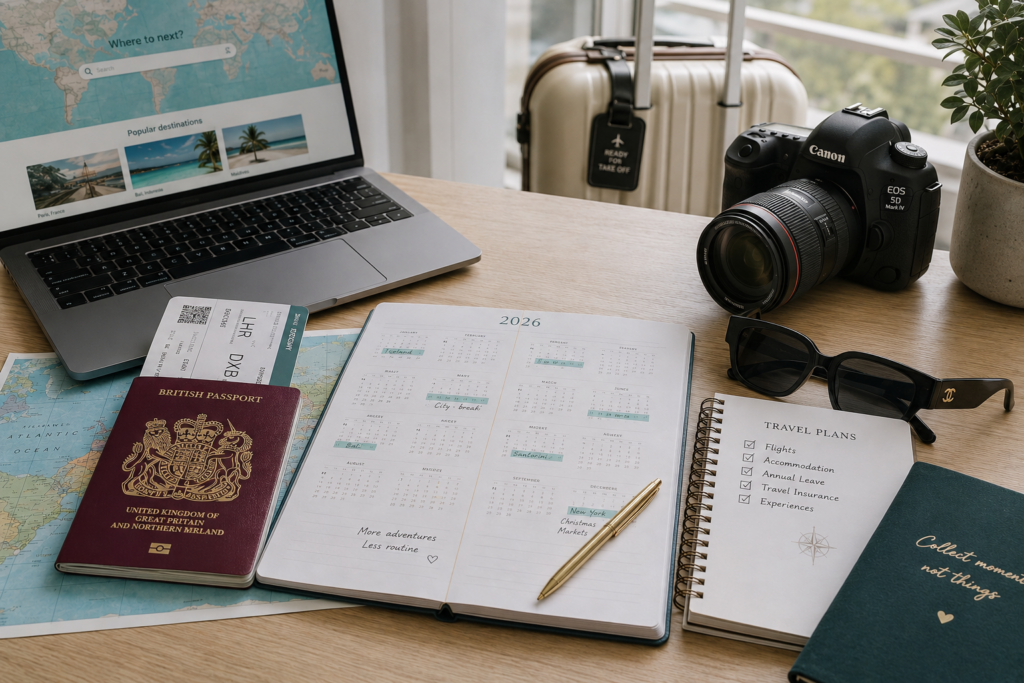
If there’s one travel hack that’s allowed me to see more of the world while working full-time, it’s learning how to maximise my annual leave.
People often assume you need unlimited holiday allowance or a fully remote job to travel frequently, but that’s rarely the case. With a little forward planning, you can turn the same number of annual leave days into more holidays, longer trips and better travel experiences.
Rather than booking leave whenever I find a cheap flight, I start by looking at my calendar. I identify weekends, bank holidays and existing commitments before deciding when and where to travel. This simple habit has completely changed how I use my annual leave.
Whether I’m planning a long-haul adventure, a Caribbean cruise or a quick European city break, I try to make every day of annual leave work as hard as possible.
Here’s exactly how I do it.

Why Planning Matters
For many people, annual leave is something that’s used as and when it’s needed. A long weekend here, a day off there, and before you know it, half your allowance has disappeared without a memorable holiday to show for it.
I’ve found that treating annual leave like part of my travel planning makes a huge difference.
At the beginning of each leave year, I sit down with my work calendar and map out the months ahead. Before I’ve even chosen a destination, I already know where the best opportunities for travel are.
Planning early has several benefits:
- I can make every day of annual leave count.
- I often enjoy longer holidays without using more leave.
- Flights and hotels are usually cheaper when booked well in advance.
- Popular leave dates are less likely to be fully booked at work.
- I have exciting trips to look forward to throughout the year.
Travel doesn’t start when I arrive at the airport, it starts months earlier with a calendar and a plan.
Know Exactly What You’re Working With
Before thinking about destinations, work out exactly how much leave you have available.
I always check:
- My annual leave allowance.
- All UK bank holidays.
- Whether I can buy additional annual leave.
- Whether I can carry leave into the following year.
- Any company shutdowns.
- Any periods where annual leave is restricted.
Once I know how many days I have to play with, I can start using them strategically.
It’s also worth checking your employee benefits. Many companies now offer more flexibility than people realise, and taking advantage of those policies can easily add several extra travel days throughout the year.
Build Your Calendar Before Booking Anything
I don’t start by deciding where I want to go. Instead, I start with the calendar. I block out:
- Weekends.
- UK bank holidays.
- Weddings and family events.
- Busy periods at work.
- Existing travel plans.
Once everything is visible, opportunities begin to appear naturally.
You might notice a bank holiday sitting next to a quiet week at work, or two long weekends that could easily become one much longer trip. Only after I’ve mapped the entire year do I start choosing destinations.
I also think carefully about the seasons. Some destinations are best visited in spring, others in autumn or winter. Planning the whole year together allows me to match each destination with the best time to visit, rather than simply travelling whenever I happen to have leave available.
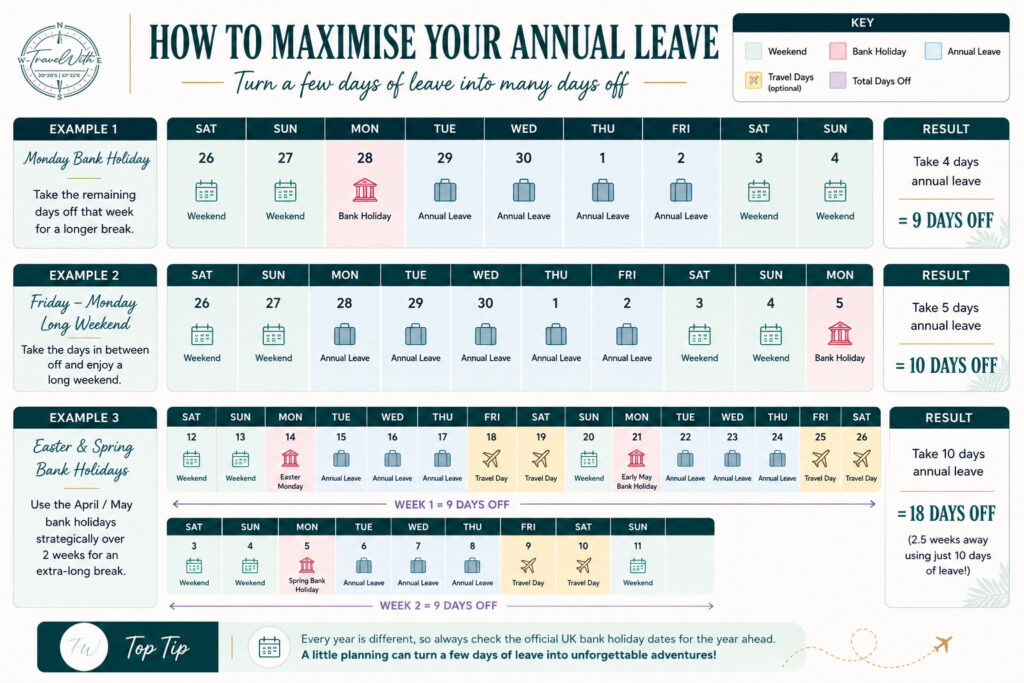
My Favourite Time of Year to Travel: Easter & Spring Bank Holidays
If you’re based in the UK, one of the easiest ways to maximise your annual leave is to take advantage of the Easter and spring bank holidays.
This is almost always when I book one of my biggest holidays of the year.
The Easter period naturally creates longer breaks thanks to Good Friday and Easter Monday, making it one of the best opportunities to travel further afield without using a huge amount of annual leave.
Rather than seeing a bank holiday as simply an extra day off, I use it as the foundation for a much longer holiday.
For example, if a bank holiday falls on a Monday, you have two great options.
You can take the remaining working days that week off, giving yourself a long break with only a handful of annual leave days.
Alternatively, you can take the working days before the bank holiday off and stretch your holiday across two weekends.
Both approaches allow you to maximise your time away while using fewer annual leave days than you might expect.
The real beauty for UK residents comes during April and May. Between Easter, the Early May Bank Holiday and the Spring Bank Holiday, there are multiple opportunities to create extended holidays across just a few weeks.
With a little planning, you can use these bank holidays strategically to spend considerably longer at your destination. I find this works especially well for long-haul travel because spending two days flying feels much more worthwhile when I’m able to stay for longer.
Instead of rushing through a destination, I have time to explore properly, recover from jet lag and enjoy a much slower pace of travel. It’s one of the biggest reasons I’m able to fit more memorable trips into the year without needing any additional annual leave.
As soon as the new bank holiday calendar is released, these are usually the first dates I look at when planning my travel year.
Save Long Weekends for Short Trips
Not every holiday needs to be two weeks long.
One of the biggest mistakes people make is using a full week of annual leave for destinations that are only a short flight away. I prefer to save my larger blocks of leave for long-haul adventures and use long weekends for destinations that are much closer to home.
For me, Europe is perfect for a three or four-day escape.
Whether it’s wandering through the streets of Prague, relaxing on the beaches of Mallorca or exploring the Christmas markets in Germany, a long weekend is often enough to experience somewhere new without using a significant amount of annual leave.
By reserving longer holidays for destinations that genuinely need more time, I can usually fit several European breaks into the year alongside one or two bigger adventures.
It’s about matching the length of your holiday to the destination rather than automatically taking a full week every time.
Book as Early as Possible
Once my annual leave has been approved, I don’t wait around. I book my flights and accommodation as early as possible.
Not only does this usually mean better prices, but it also gives me more choice when it comes to hotels, flight times and seats. Booking early also allows me to spread the cost over several months rather than paying for everything closer to departure.
Perhaps more importantly, it gives me something exciting to look forward to. Knowing that I’ve already got my next trip planned makes the working weeks feel that little bit easier, and it means I’m much less likely to waste annual leave on last-minute decisions.
Always Leave Yourself a Recovery Day
I used to make the mistake of flying home late on Sunday and going straight back to work on Monday morning.
I quickly realised that I wasn’t really enjoying the last day of my holiday because I was already thinking about work. Now, whenever possible, I build in one recovery day before returning to work.
That extra day gives me time to:
- Unpack my suitcase.
- Catch up on laundry.
- Restock the fridge.
- Recover from jet lag.
- Get back into my normal sleep routine.
- Mentally reset before returning to work.
It makes coming home feel far less stressful and helps me enjoy my holiday until the very end.
If I can’t manage a full recovery day, I’ll often try to return home earlier in the day instead of landing late at night.
My Best Annual Leave Hacks
After years of balancing a full-time career with my love of travel, these are the tips that have genuinely made the biggest difference.
1. Buy Extra Annual Leave If You Can
Many employers now allow staff to buy additional annual leave each year.
If your company offers this benefit and it’s financially affordable, I almost always take advantage of it. I’m a big believer in working hard and playing hard. Time away isn’t just about visiting new countries, it’s about switching off, recharging and returning to work feeling refreshed. For me, travelling is how I reset.
Having a few extra days each year gives me the flexibility to extend a holiday, squeeze in another city break or simply spend longer exploring somewhere I’ve always wanted to visit. Those extra days often create memories that far outweigh the cost of purchasing them.
2. Carry Annual Leave Into the Next Leave Year
Another benefit that’s often overlooked is carrying annual leave over.
Many employers allow you to carry a small number of unused days into the following leave year. If I know I’ve got a big holiday planned, I’ll deliberately save some leave so I can combine it with my new allowance. Those additional days can make all the difference if you’re planning a once-in-a-lifetime trip or a destination that deserves more than just a week away.
Always check your company’s policy, ou may have more flexibility than you realise.
3. Don’t Underestimate Half Days
Half days are one of the most underrated travel hacks.
Instead of taking a full day off just to catch an evening flight, I’ll often use a half day and head straight to the airport after work. The same works on the return journey. A morning flight may still allow you to work part of the afternoon depending on your employer’s policy.
It doesn’t sound like much, but over the course of a year those half days can save several full days of annual leave.
4. Make the Most of Flexible Working
If your employer offers flexible hours, hybrid working or time off in lieu, make the most of it where appropriate.
Sometimes there are small pieces of work that can easily be completed while travelling. Could you read a report on the train to the airport? Review a presentation during a long-haul flight? Catch up on mandatory reading while waiting at the departure gate?
Of course, this should always be agreed with your employer first and only if it’s appropriate for the work you’re doing. Confidential documents or company policies may make this unsuitable.
The goal isn’t to work throughout your holiday, it’s simply to make your travel time work a little harder when it makes sense.
5. Consider the Journey Time
When planning a holiday, I always think about how much time I’ll actually spend at my destination.
If I’m flying halfway around the world, I want to make the journey worthwhile. That’s why I usually save my longer blocks of annual leave for long-haul destinations such as Asia, the Caribbean or North America, where spending two days travelling for a short break simply doesn’t make sense.
For destinations closer to home, however, a long weekend is often all I need. Europe is perfect for a three or four-day getaway, allowing me to experience somewhere new without using a large chunk of my annual leave.
Matching the length of your holiday to the travel time helps you get much better value from your annual leave. It also means you have enough time to recover from jet lag, settle into your destination and enjoy the trip without feeling like you’re constantly rushing.
By thinking about the journey as well as the destination, I can fit more meaningful trips into the year while making every day of annual leave count.
My Annual Leave Planning Checklist
Every January, I ask myself the same questions before booking anything.
- ✓ When are all of this year’s bank holidays?
- ✓ Which destinations are best during each season?
- ✓ Which holidays only need a long weekend?
- ✓ Which destinations deserve a full week or more?
- ✓ Can I buy additional annual leave?
- ✓ Can I carry any leave over?
- ✓ What’s my travel budget for the year?
- ✓ When should I start booking flights and hotels?
Spending just an hour planning my year saves me time, money and annual leave in the long run.
Final Thoughts
You don’t need unlimited annual leave to travel more, you simply need a better strategy.
By planning around weekends and bank holidays, making use of your company’s annual leave policies and thinking carefully about how you use every day, you can enjoy more trips throughout the year without increasing your holiday allowance.
For me, travel doesn’t begin when I arrive at the airport.It starts months before, with a calendar, a cup of coffee and a little forward planning.
That simple habit has allowed me to see more of the world while working full-time, and I hope it helps you do the same.
After all, annual leave is one of the most valuable benefits we receive from our employers. Use it wisely, and you’ll create memories that last far longer than the working week.